


Archived session commentary. The dated market examples below are retained; the expiration and hedging mechanics were clarified during the October 2026 educational review. Educational material, not individualized investment advice.

There is a specific kind of day that separates traders who have a process from traders who have a habit. It does not look dangerous. That is what makes it dangerous. The chart is open, the names are moving, your platform is on — and the tape is quietly rigged against every decision you are about to make.
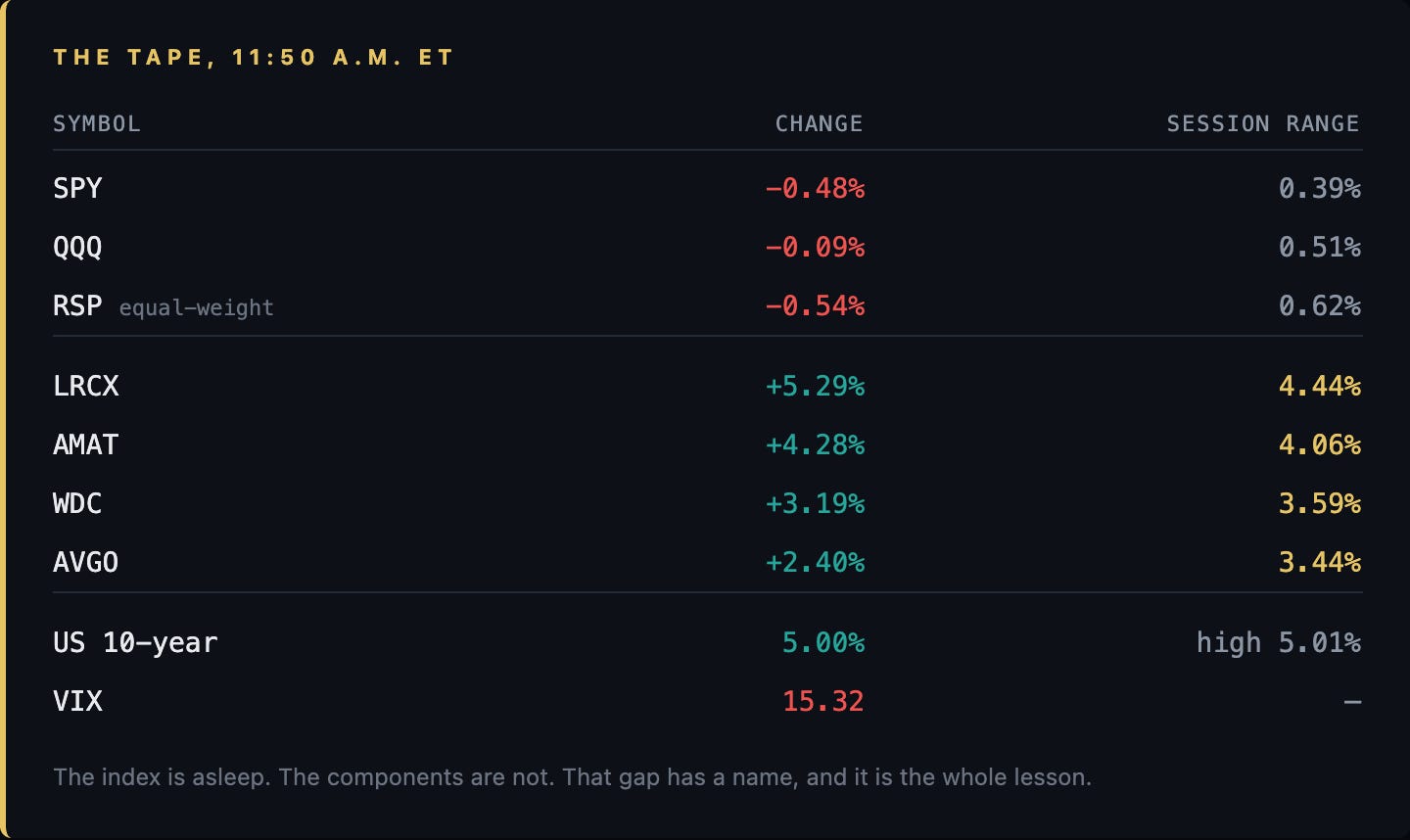
Today is monthly options expiration. As I write this at 11:50 a.m. ET, the S&P 500 ETF has traveled a grand total of 0.39% — high to low, all session. Lam Research has traveled 4.44% in the same window.
Same clock. Same market. Eleven times the movement in a single name versus the index that supposedly contains it. If you do not understand why that is happening, the tape is going to take money from you today and you will blame your entry.
I. What expiration actually does
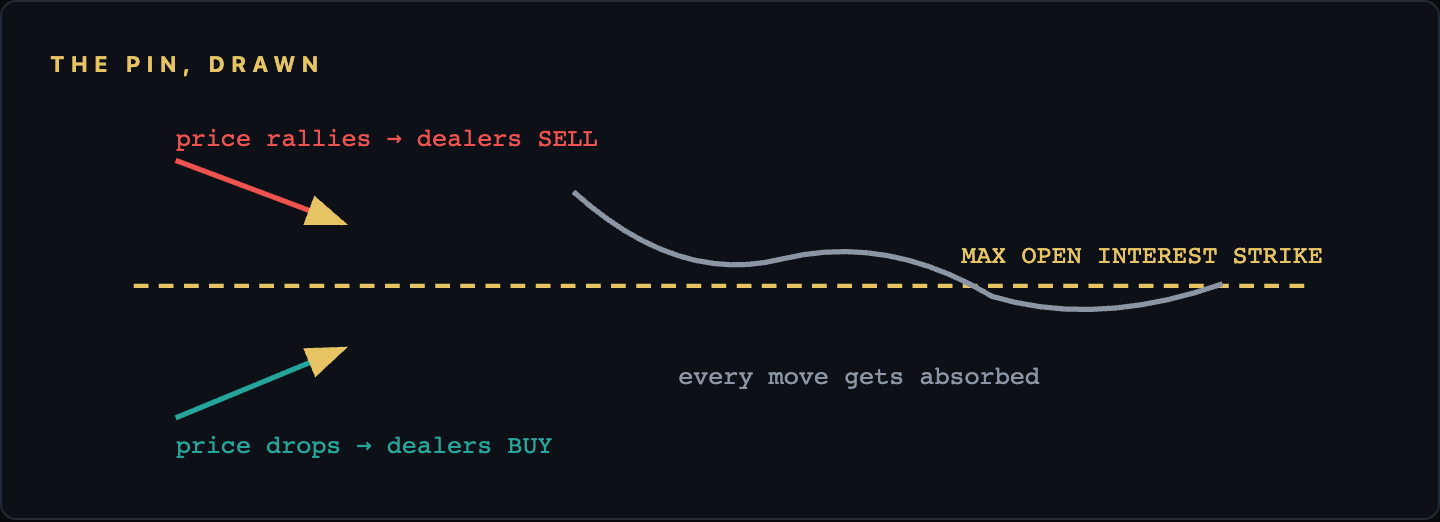
Many standard monthly equity options expire on the third Friday, while weekly and daily expirations and product-specific settlement rules also matter. Expiration does not imply that all contracts settle together or that price must remain near a strike.
Correction: The original version reversed the hedging direction for a short-gamma position. A dealer with net negative gamma who maintains a delta hedge generally buys underlying exposure as price rises and sells as it falls. Net positive gamma can lead to the opposite hedge adjustments. Actual net positioning, other flows and liquidity determine the market effect; open interest alone does not establish dealer exposure or guarantee a pin.
Source: Cboe research on gamma and market-maker hedging. The practical lesson is to assess the observed range, liquidity and your strategy’s conditions rather than treating expiration as an automatic explanation for every failed breakout.
II. Dead tape, in full
“Dead tape” gets used loosely to mean “boring.” That is not what it means. Dead tape is a measurable state with a specific signature, specific causes, and a specific way of separating you from your money. Here it is completely.
What it is
Dead tape is when price movement stops being information. In a healthy market, a move up tells you buyers showed up — the move carries a message about supply and demand. In dead tape, price still moves, but the movement is noise generated by hedging, rebalancing, and thin two-sided liquidity. The chart still makes shapes. The shapes mean nothing. You are reading tea leaves that were stirred by a machine that has no opinion.
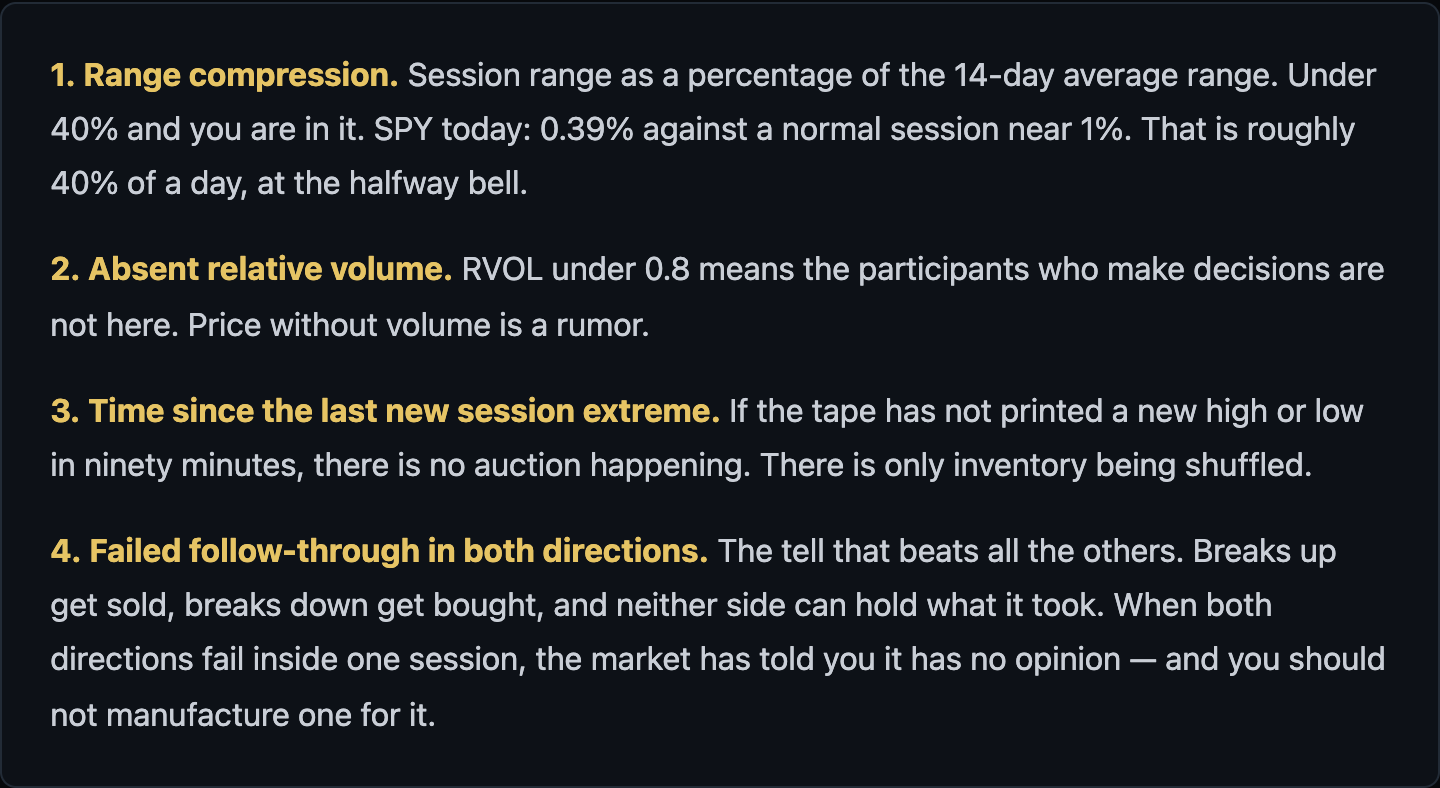
How to identify it — four measurements, not a feeling
Why it costs you money — the five mechanisms
It pays both sides of your stop. A compressed range means your stop and the stop of the person taking the other side sit within a few ticks of each other. Thin tape reaches both. You get stopped long, reverse, get stopped short, and the session closes exactly where it opened. You were right about the level twice and you paid for it twice.
It bleeds premium while you wait. If you are in options, dead tape is the worst possible environment. Long options can lose time value while the anticipated move fails to arrive; short options carry their own adverse-move and assignment risks. Being directionally correct next Tuesday does not refund what today cost you.
It manufactures signals. Every indicator you own will fire in dead tape. RSI will cross. MACD will trigger. A flag will form. These are not signals — they are the mathematical byproduct of a small denominator. Compressed ranges make oscillators hypersensitive. Your tools are working correctly and telling you nothing.
It rewards the behavior that ruins accounts. Nothing is working, so you size up to make the same dollars from a smaller move. Now you are carrying double risk in the lowest-quality conditions of the month. This is the single most common way a good month becomes a bad one, and it happens on the quietest days, not the violent ones.
It teaches you the wrong lesson. This is the expensive one. If you take eight trades in dead tape and six lose, you will conclude your strategy is broken and change it. Your strategy was fine. The conditions were unsuitable and you traded anyway. Traders destroy working systems over sample sizes gathered on days the system should never have been running.
III. The dispersion trap
Here is the part that catches experienced traders, and it is live on the screen right now. Expiration does not make everything quiet. It clamps the index while single names run free. Index options are the most heavily hedged instruments in the market. A mid-cap semiconductor equipment name is not.
So you get today: SPY locked in 0.39%, and Lam Research moving 4.44%. A trader watching the index concludes nothing is happening and stands down. A trader watching single names concludes the market is wide open and gets aggressive in an index that is going to drag everything back by 3 p.m. Both readings are half right, which in practice means both are wrong.
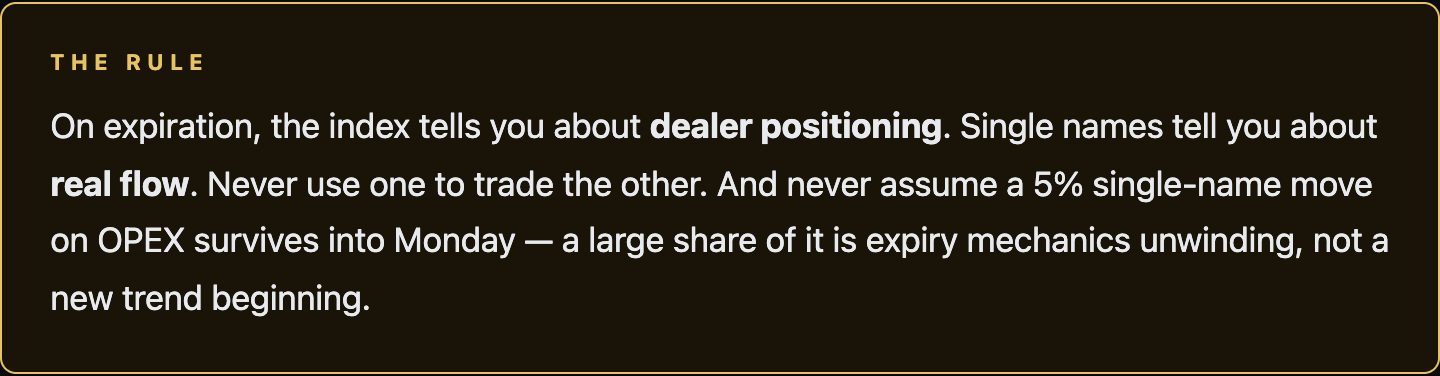
Today’s example is honest about this. The semiconductor equipment group is ripping — AMAT, LRCX, WDC, all up hard. They are also bouncing out of an 8% to 10% hole from earlier in the week. A violent bounce off a deep hole on expiration Friday is the lowest-quality bullish signal that exists. It might be the start of a repair. It might be short covering into a pin. Friday cannot tell you which, and anybody who says otherwise is selling something.
Meanwhile the ten-year just crossed 5.00%. That is the real event on the screen today, and it is getting completely masked by expiration noise. This is the other cost of trading OPEX: it camouflages the thing that actually matters.
IV. What to do instead
Not “avoid the market.” Avoid the decisions the market is not qualified to inform today.
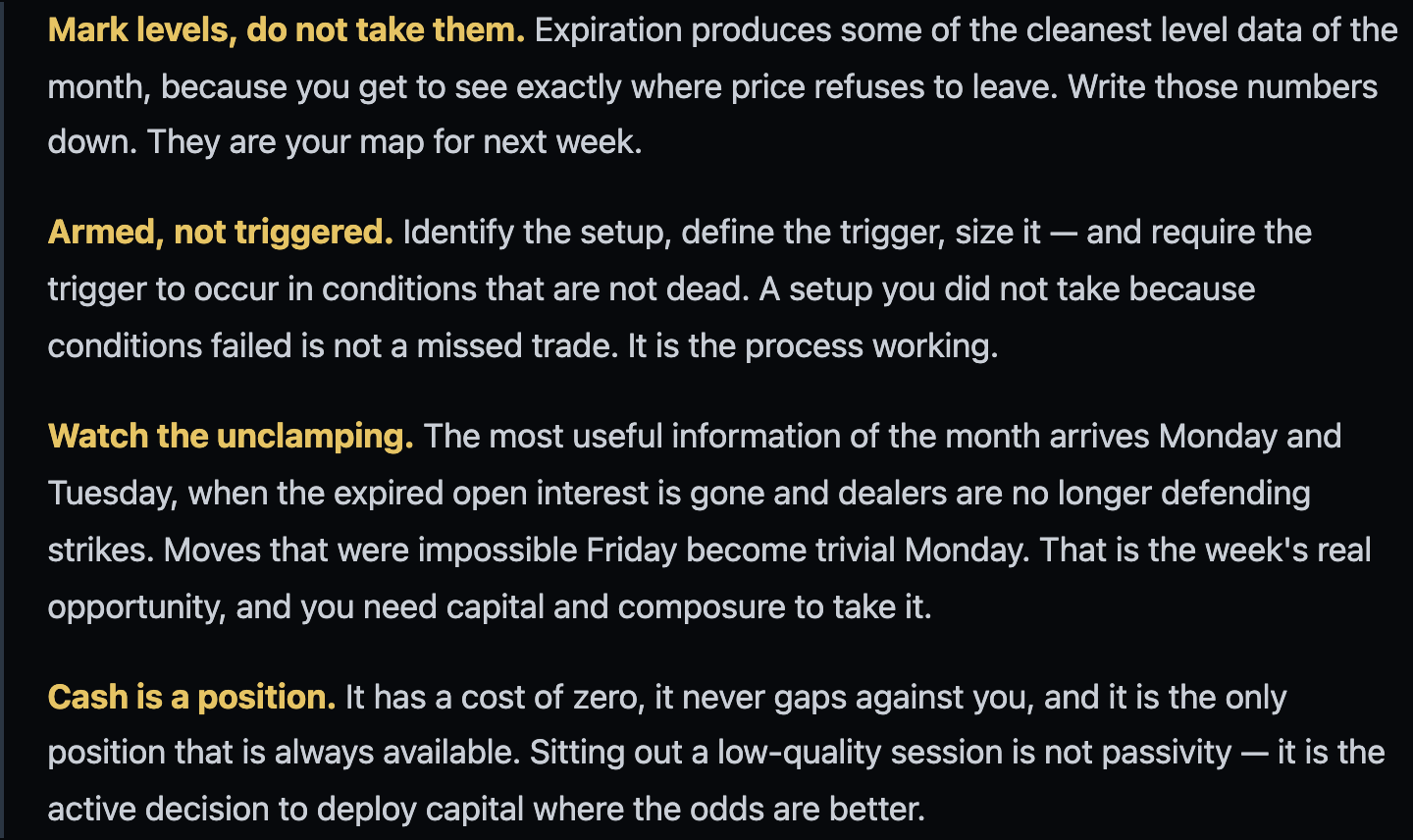
The traders who survive are not the ones who catch every move. They are the ones who recognize conditions where their edge does not apply, and refuse to donate into them. Expiration dates are knowable in advance, but quiet conditions are not guaranteed. Check the specific product calendar and the actual session before deciding whether your strategy applies.
Let it expire. Take the map. Trade next week.

